Decision Support Guide
What Is a Decision Support System? Meaning, Examples, and Why It Matters in Business
A decision support system helps people make better decisions by turning data, models, and business signals into something easier to interpret. It does not replace judgment. It supports it.
A decision support system (DSS) is a tool or system designed to help people make better decisions. It usually combines data, analysis, rules, or models so that a person can understand a situation more clearly and choose a better course of action.
In business, decision support systems are often used to reduce uncertainty. They help people compare options, notice risk sooner, understand what changed, and discuss what to do next with more clarity.
Is decision support system an old concept?
Yes, the term itself has been around for decades. It originally referred to systems that helped managers make better decisions by combining data, models, and analysis. But the idea is still highly relevant today.
Traditional decision support system
- Often described in academic or management systems language
- Focused on structured data, models, and managerial analysis
- Usually framed as a tool to support semi-structured decisions
- Frequently associated with older business information systems
Modern forms of decision support
- Dashboards used in weekly business review
- Forecasting and planning tools
- Threshold and alert systems
- AI-driven recommendations and scenario tools
What a decision support system actually does
Although the term may sound dated, the core purpose has not changed. A decision support system helps people move from raw information to clearer judgment. What has changed is the form. Today, decision support often appears through dashboards, planning tools, alerts, and other systems built into everyday business workflow.
It organizes information
A DSS pulls together the data or inputs that matter for a decision so people do not have to search across different reports and systems.
It reduces uncertainty
A stronger system makes it easier to understand what changed, what matters most, and where risk or opportunity may be building.
It improves discussion quality
Instead of spending the whole meeting explaining numbers, teams can move faster into priority, trade-offs, and next-step discussion.
Decision support system examples in business
The original idea of decision support system may come from an earlier era of management systems, but the concept is still alive in modern business. Today, decision support appears in many forms, from executive dashboards to forecasting tools and alert-based systems that help teams act sooner.
Executive dashboards
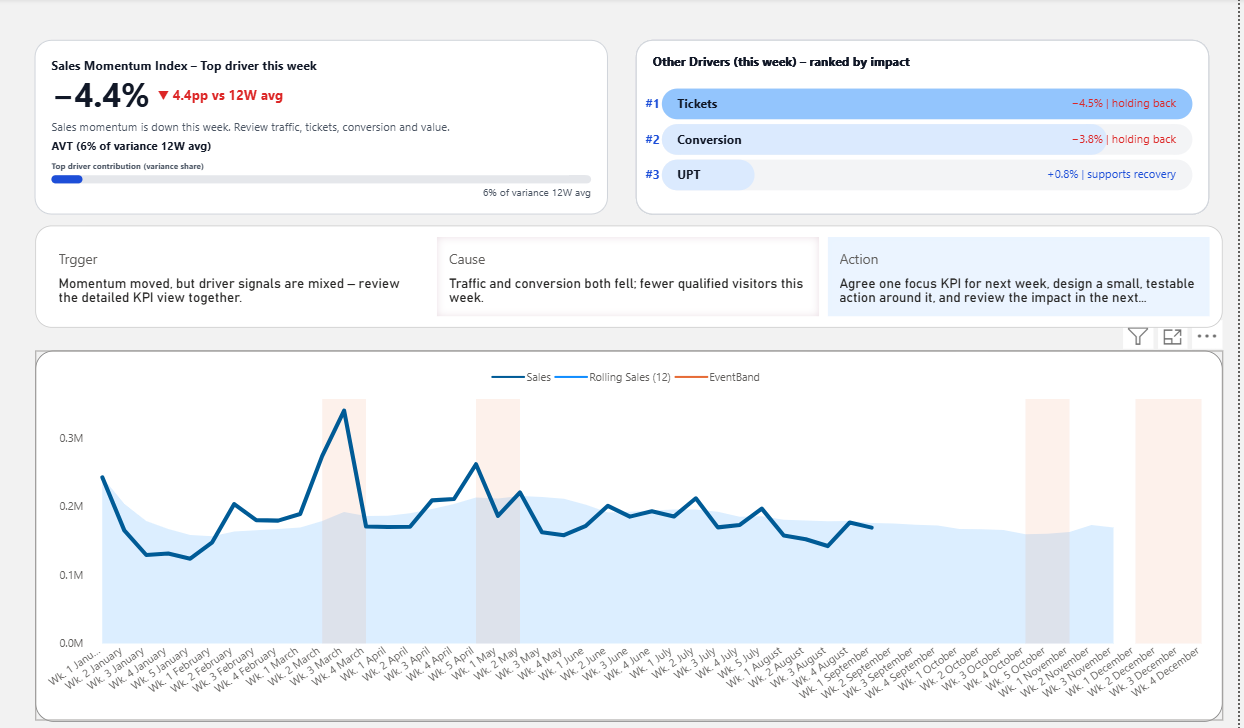
A well-structured dashboard can function as a decision support system when it helps leaders see condition, priority, and likely drivers rather than simply listing KPIs.
Sales forecasting tools
Forecasting systems support decision-making by helping teams estimate future demand, revenue, or pipeline movement before making commercial or operational decisions.
Inventory planning systems
These tools help planners decide when to reorder, where stock risk is rising, and which products need attention first.
Scenario planning models
Scenario tools help businesses compare different actions before committing to one, such as pricing changes, hiring plans, or budget shifts.
Threshold and alert systems
Some decision support systems notify teams when a KPI crosses a critical point, making it easier to act before the problem becomes larger.
Weekly business review systems
In many companies, a weekly review dashboard becomes a decision support system when it helps teams move from reporting into focused business discussion more quickly.
What makes a decision support system useful?
Not every tool with data is truly useful for decision support. The strongest systems do more than present information. They help people notice what matters sooner and discuss the right issue first.
Weak decision support
- Shows data without priority
- Requires too much manual explanation
- Creates too many equal signals
- Leaves next steps unclear
Strong decision support
- Clarifies where attention should go first
- Helps teams understand what changed
- Connects performance to likely drivers
- Improves the quality of business discussion
Why this matters
A dashboard is often the most visible form of decision support
In many organizations, dashboards are the tool people use most often when trying to understand business performance. That is why dashboard design matters so much.
A dashboard can either create more reporting work or act as a stronger decision support system. The difference is not visual polish alone. The difference is whether it helps people identify what matters and where the next business conversation should begin.