Decision Support Guide
Decision Support System Examples: 7 Real Ways Businesses Use Them
Decision support systems are meant to help people make better decisions, faster. In practice, they can take many forms: dashboards, forecasting models, scenario tools, alerts, and other systems that help teams understand what is happening and what needs attention next.
Many people search for decision support system examples because they want something practical. Not a theory-heavy definition. Not a vague explanation. They want to understand what a decision support system actually looks like in business.
The answer is broader than many people expect. A decision support system can be a forecasting tool, a dashboard, a recommendation engine, a scenario planner, or even a structured review system that helps teams focus on what matters first.
7 decision support system examples in business
These examples show how decision support appears in real organizations. Some are advanced systems. Some are simple tools with a strong structure. What they have in common is that they help people move from information to better judgment.
1. Executive performance dashboards
A well-designed executive dashboard is one of the clearest decision support system examples. It helps leaders see what changed, where risk is building, and which area deserves discussion first.
2. Sales forecasting systems
Forecasting tools support decisions by helping teams estimate future demand, revenue, or pipeline movement. They are useful when they do more than predict numbers and actually help teams prepare responses.
3. Inventory and replenishment tools
In supply chain and retail, decision support systems often appear as inventory planning tools. These systems help teams decide when to reorder, where to reduce stock, and which items carry the biggest risk.
4. Scenario planning models
Scenario tools allow businesses to compare possible futures before acting. For example, teams may compare pricing options, hiring plans, or budget changes to see which direction creates the strongest outcome.
5. Alert and threshold systems
Some decision support systems are built around triggers. When a KPI crosses a threshold, a warning appears. This helps people act earlier instead of waiting until a larger problem becomes visible in the monthly report.
6. Recommendation engines
Recommendation systems suggest actions based on patterns in the data. In e-commerce, they may recommend products. In operations, they may suggest routing or scheduling decisions.
7. Weekly business review dashboards
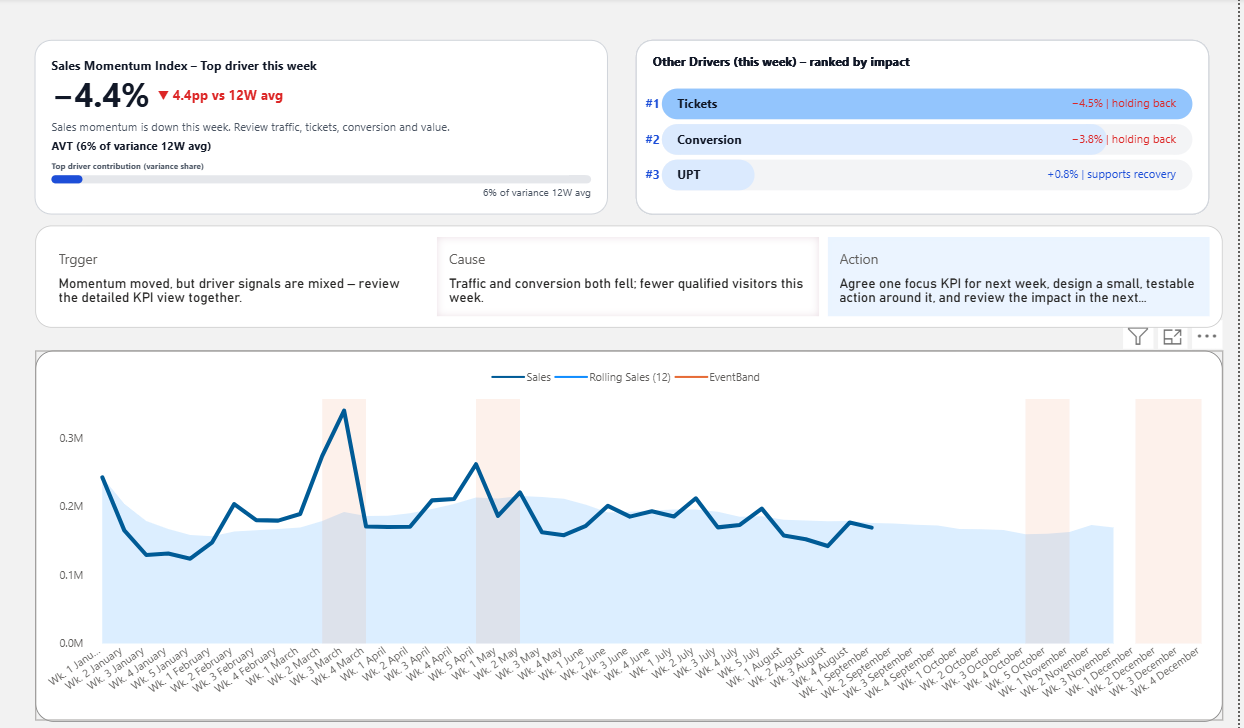
A weekly business review dashboard can function as a decision support system when it does more than summarize performance. The stronger version helps teams identify signal, driver, and next discussion point before the meeting drifts into scattered analysis.
What makes a decision support system actually useful?
Not every system with data qualifies as useful decision support. The stronger examples do not just display information. They reduce uncertainty, help teams prioritize faster, and improve the quality of the next business conversation.
What weaker systems do
- Show data without priority
- Require heavy interpretation in meetings
- Surface too many equal signals
- Leave action unclear
What stronger systems do
- Clarify what deserves attention first
- Reduce explanation burden
- Connect condition to likely drivers
- Support a better next-step discussion
A practical example
Why dashboards are still one of the most important decision support tools
Among all decision support system examples, dashboards remain one of the most common. But their quality varies dramatically. A dashboard can either create more reporting work or make decisions easier.
The difference is not whether the dashboard looks modern. The difference is whether it helps people recognize condition, understand what matters most, and begin the right discussion sooner.