
Decision Support Guide
Decision Support System Tools: 7 Types Businesses Use to Make Better Decisions
Decision support system tools help people make better decisions by organizing information, highlighting what matters, and reducing uncertainty. They can take many forms, from dashboards and forecasting tools to alerts, scenario models, and recommendation systems.
When people search for decision support system tools, they are usually looking for something practical. They want to know what kinds of tools businesses actually use to support decisions, not just the academic definition of a decision support system.
The answer is broader than it first appears. Decision support tools are not limited to one category of software. In business, they often include dashboards, planning systems, forecasting tools, scenario models, alert systems, and other tools that help teams make better decisions with more clarity.
7 types of decision support system tools
Different businesses rely on different decision support tools depending on the type of decision they need to make. Some tools help teams monitor performance. Others help them forecast, compare options, or respond faster when risk appears.
1. Dashboards
Dashboards are one of the most common decision support system tools. They help teams review performance, track KPIs, and identify what deserves attention first.
2. Forecasting tools
Forecasting systems help businesses anticipate future outcomes such as demand, sales, or revenue movement. They are useful because decisions often need to be made before the result becomes visible.
3. Planning and budgeting tools
Planning tools support decisions by helping businesses allocate resources, compare budget scenarios, and choose between competing priorities.
4. Scenario analysis tools
Scenario tools help decision-makers compare possible actions before choosing one. For example, teams can test pricing changes, hiring assumptions, or supply shifts and compare likely outcomes.
5. Alert and threshold systems
These tools notify teams when performance crosses a critical point. Their value comes from helping teams act sooner rather than waiting for a problem to appear in a later report.
6. Recommendation systems
Recommendation tools suggest possible actions based on patterns, rules, or models. In some businesses they support customer decisions. In others they support inventory, routing, or operational choices.
7. Management reporting systems
Structured management reporting systems can also function as decision support tools when they help leaders review performance in a way that makes priority and next discussion clearer.
Which decision support tools are most useful?
The answer depends on the kind of decision a business is trying to make. But the strongest tools usually share one thing: they do not just display information. They help people interpret what matters and decide what to discuss or do next.
Tools that stay descriptive
- Show data without priority
- Require heavy explanation in meetings
- Provide visibility but little guidance
- Surface too many equal signals
Tools that improve decisions
- Make important changes easier to detect
- Support faster prioritization
- Reduce interpretation burden
- Improve the starting point of discussion
A tool businesses already use
Why dashboards remain one of the most important decision support tools
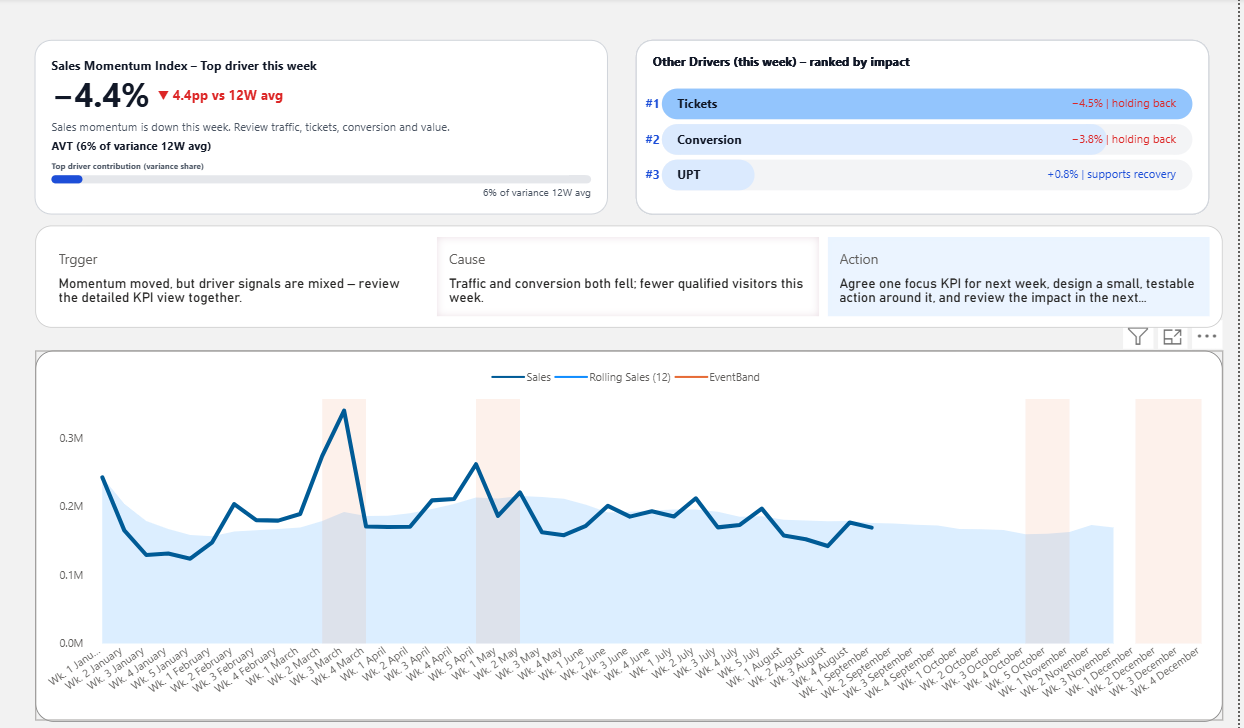
Among all decision support system tools, dashboards remain one of the most visible and widely used. But not every dashboard truly supports decision-making.
Some dashboards simply organize information. Stronger dashboards help people recognize condition, understand what matters most, and begin the right business conversation more quickly.
What makes a decision support tool actually useful?
A useful decision support tool does more than deliver access to data. It helps a person or team understand what changed, where attention should go first, and which issue deserves discussion before the meeting turns into scattered analysis.
Clear condition
People should be able to see quickly whether the situation is healthy, stable, or becoming risky.
Visible priority
The system should help users identify what matters most instead of treating every signal as equally important.
Better discussion flow
Stronger tools make it easier to move from reporting into action-oriented conversation.