
Decision Support Guide
Business Decision Support System: How Companies Use Data to Make Better Decisions
A business decision support system helps companies make better decisions by turning data, analysis, and business signals into a clearer basis for action. It does not remove judgment. It improves it.
A business decision support system is a system, tool, or structure that helps managers and teams make better business decisions. It usually combines data, reporting, analysis, models, or rules so that people can understand what is happening more clearly and choose a better next step.
In business, decision support matters because most decisions are made under uncertainty. Teams need to evaluate performance, compare options, identify risk, and act before problems grow larger.
Why companies need business decision support systems
Modern businesses do not struggle because they lack data. More often, they struggle because data alone does not make decisions easier. A business decision support system helps turn information into clearer business judgment.
Too much information
Teams often have access to many reports, dashboards, and KPIs, but still spend too much time figuring out what deserves attention first.
Too much uncertainty
Businesses make decisions before the outcome is fully known. Decision support helps reduce uncertainty and improve confidence.
Too much explanation work
In many meetings, the discussion stays stuck in reporting and interpretation. Stronger systems make it easier to move toward priority and action.
Examples of business decision support systems
Business decision support can appear in many forms. Some systems are highly technical. Others are simpler but still effective because they help people focus on what matters.
Executive dashboards
Dashboards support business decisions when they help leaders see condition, priority, and likely drivers instead of simply displaying KPIs.
Forecasting systems
Forecasting tools help companies make decisions before results become visible, especially in sales, demand planning, and operations.
Budget and planning tools
These systems help companies compare resource allocation options, prioritize investment, and manage trade-offs more clearly.
Scenario analysis tools
Scenario models allow decision-makers to compare possible futures before committing to one path.
Threshold and alert systems
Alert-based systems support decisions by making emerging risk visible sooner, before the issue becomes more expensive to solve.
Weekly business review systems
A strong weekly review system helps teams identify what changed, what matters most, and where the next business conversation should begin.
One of the most common forms
Why dashboards are central to business decision support
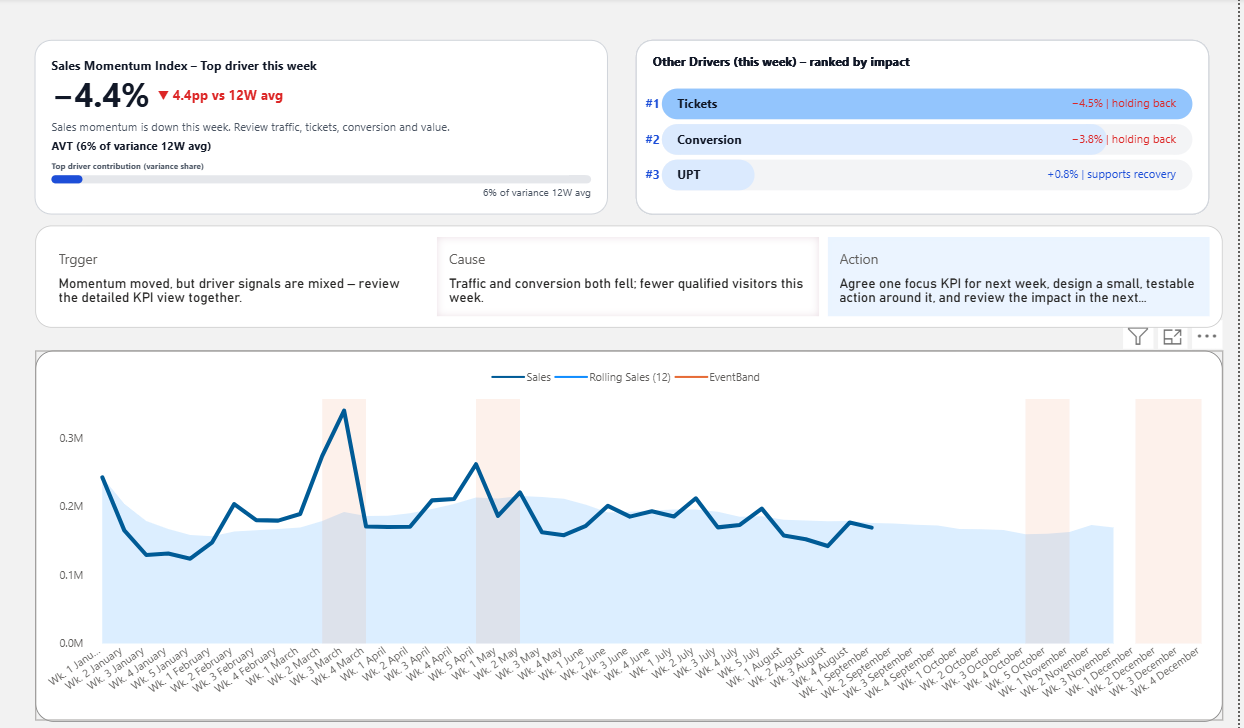
In many companies, dashboards are the most visible business decision support system. But not every dashboard truly supports decisions.
Some dashboards only make information visible. Stronger dashboards help teams understand what changed, what matters first, and where the meeting should focus next.
What makes a business decision support system effective?
The strongest business decision support systems do not just provide data access. They improve how people interpret business condition and how quickly they align on the next important issue.
Weak support
- Shows data without priority
- Creates too many equal signals
- Requires heavy interpretation
- Leaves next steps vague
Strong support
- Clarifies what deserves attention first
- Connects performance to likely drivers
- Improves meeting quality
- Supports clearer discussion and action