
Weekly Review Playbook
Weekly Business Review Playbook: How to Run Better KPI Meetings with Power BI
Many weekly KPI meetings do not fail because teams lack numbers. They fail because the review structure does not make priority, business context, and next-step discussion clear enough. This playbook shows a better way to run the meeting.
A strong Weekly Business Review should do more than repeat what happened last week. It should help teams review performance efficiently, identify what matters first, discuss likely causes, and leave the meeting with stronger alignment.
Without that structure, weekly meetings often become a loop of explanation, extra reporting, and delayed action. The goal of this playbook is to make the meeting itself more useful.
Why weekly KPI meetings often feel repetitive
Many teams already have dashboards, KPI updates, and recurring business reviews. But the presence of reporting alone does not guarantee a good weekly meeting.
Too much reporting
The meeting spends too much time re-reading numbers because the dashboard does not make KPI condition clear enough at a glance.
Too little priority
Teams see many metrics, but do not quickly agree on what deserves attention first.
Weak action flow
Discussion often stops at observation because the review does not naturally move from signal to cause to next action.
A better Weekly Business Review flow
A useful weekly review meeting follows a simple sequence. The dashboard should help the team move through these stages without getting stuck in repeated interpretation.
Start with signal
Begin with the KPI or business signal that most clearly shows whether performance is healthy, weak, improving, or at risk.
Surface likely drivers
Bring forward the drivers most likely to explain the movement instead of asking the room to search everywhere at once.
Clarify business meaning
Discuss what the result means for the business now, not just what changed numerically.
Decide the next step
End with a clear action direction, owner, or follow-up question so the meeting creates momentum rather than more ambiguity.
The playbook: how to run the meeting
This is a practical structure for a weekly KPI meeting that aims to reduce explanation time and improve action quality.
Step 1
Open with the KPI that deserves attention first
Do not begin by reading every number in sequence. Start with the KPI that best reflects the current business condition or the most important movement this week.
Step 2
Use the dashboard to narrow the field
The dashboard should reduce the search space. It should make likely drivers visible enough that the meeting does not waste time guessing where to look.
Step 3
Discuss why the movement matters
Avoid treating KPI changes as isolated numbers. Connect them to business implication, risk, and what the team should care about this week.
Step 4
Agree on action or direction before closing
The meeting should not end with “let’s monitor this” unless that is a deliberate choice. Decide the next move, owner, or follow-up needed.
Dashboard role in the meeting
The dashboard should reduce friction before discussion expands
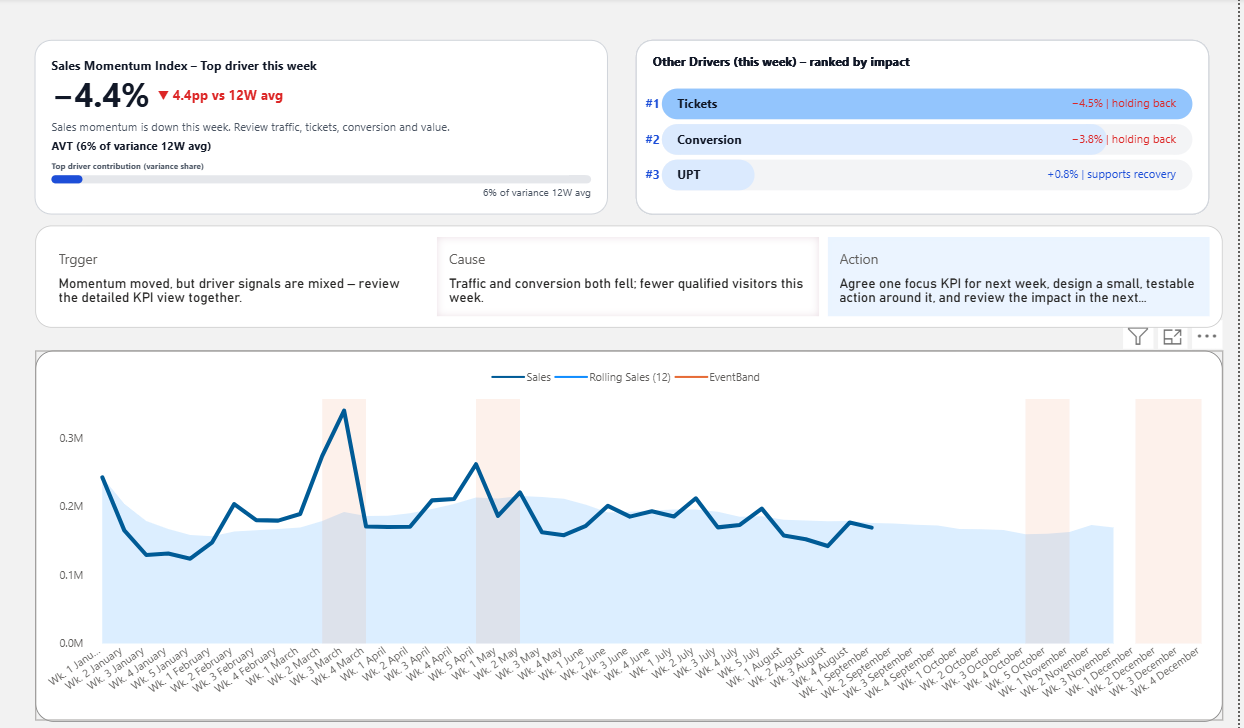
A good weekly review dashboard does not replace discussion. It improves the starting point of the discussion by making performance condition, likely drivers, and business context easier to see.
- Faster KPI interpretation
- Earlier alignment on priority
- Less repetition in the meeting
- Stronger bridge to action discussion
What improves when the review structure improves
Better weekly review meetings usually feel simpler, but the effect is larger than simplicity alone.
Reporting gets clearer
KPI review becomes easier to follow and less dependent on verbal explanation from the presenter.
Meetings get more focused
Teams spend less time deciding where to look and more time discussing what matters most.
Actions get stronger
The meeting is more likely to end with a useful decision, direction, or next-step alignment.
Next step
Use a dashboard structure built for weekly review quality
Explore the decision-ready Power BI template designed to improve KPI clarity, driver visibility, and weekly business review discussion.