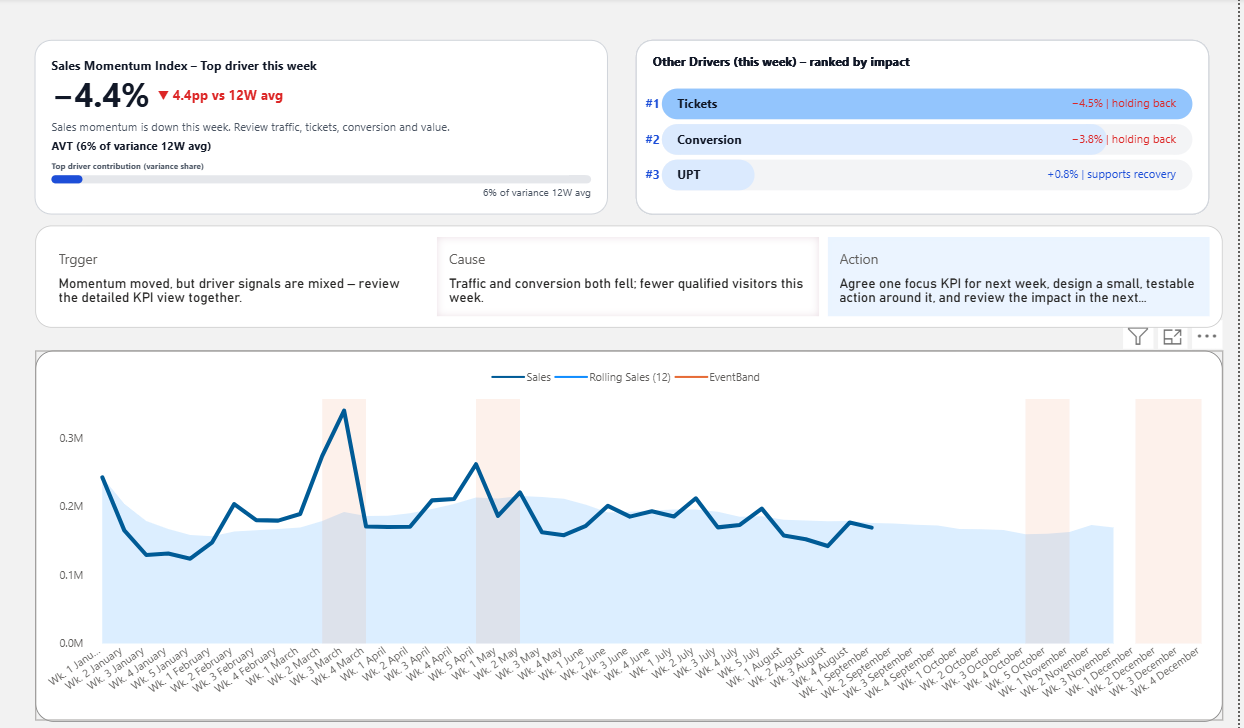
Why Teams Go Back to Excel Even When Dashboards Exist
Dashboards were supposed to replace manual spreadsheets.
Yet people still
export, copy, and rebuild views in Excel.
This isn’t just “old habits” —
it’s a signal that your dashboards are not supporting judgment.
or don't help users to find what they really need.
What this looks like in practice
When teams quietly go back to Excel, you may notice:
- People download the same report every week and rearrange it in their own files.
- Important discussions happen in screenshots and Excel attachments, not in the dashboard itself.
- Managers ask for “raw data” even when a dashboard view already exists.
- Different versions of the truth appear in different spreadsheets.
On the surface, this looks like a tooling preference. Underneath, it’s usually a structural issue.
Why Excel feels “easier” than the dashboard
Excel lets people impose their own decision structure on the data:
- They can group numbers around the question they need to answer today.
- They can hide details that are not relevant to the decision.
- They can test “what if” ideas without changing anything for others.
When a dashboard is missing that structure, it becomes a place to collect data, not a place to decide.
So people use the dashboard to pull numbers, then switch to Excel to do the real thinking.
The structural gaps behind “back to Excel”
Most teams go back to Excel when dashboards lack one or more of these elements:
- Clear triggers — no obvious signal that says “this has changed enough to matter”.
- Decision-specific views — the same layout is used for weekly checks, deep dives, and ad-hoc questions.
- Action paths — the dashboard shows what happened, but not what kind of response is expected.
- Data Flow for decisions — all important KPIs are shown but not creating flow how users would see.
Excel isn’t competing with your dashboard as a tool. It is filling a gap in your decision design.
When people rebuild views in Excel, they are telling you what kind of structure your dashboards are missing. It’s feedback — not resistance.
If you already know this applies to you, you don’t need to read more.