
Decision Systems
Decision Support System: Why Modern Dashboards Still Fail to Support Decisions
Dashboards have replaced many traditional reporting tools. But replacing reports is not the same as supporting decisions.
The term Decision Support System (DSS) has been used for decades to describe systems that help people make better business decisions.
In principle, the idea is simple.
A decision support system should do more than store data. It should help people understand a situation, evaluate what matters, and move toward action.
Today, many dashboards are treated as the modern version of a decision support system.
They show metrics. They reveal trends. They compare targets and actuals.
But in many organizations, one familiar moment still happens:
“Let’s analyze this further.”
The dashboard showed the issue. But the decision still did not become clear.
Definition
What is a decision support system?
A decision support system is a system designed to help people make better decisions by organizing information, analysis, and relevant signals.
In practice, this usually means helping people answer questions such as:
- What is happening?
- Why is it happening?
- What deserves attention now?
- What should we do next?
The important point is this:
A real decision support system does not just display information. It helps structure attention and response.
The Modern Reality
Why dashboards became the modern DSS
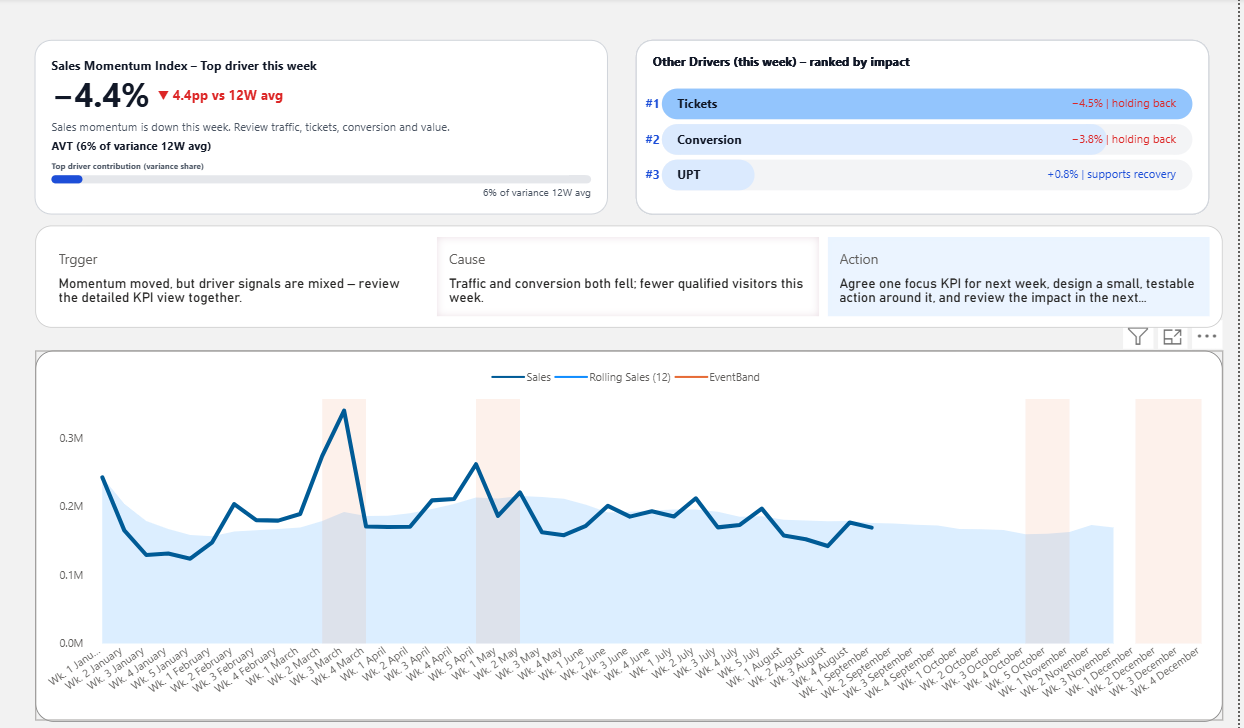
In many companies, dashboards now play the role that decision support systems were meant to play.
Executives review dashboards in weekly meetings. Teams use them to monitor performance. Leaders expect them to support business judgment.
In other words, dashboards have become the visible interface of modern decision support.
But visibility alone is not the same as decision support.
The Problem
Why most dashboards still fail as decision support systems
Too much interpretation
Dashboards often show the same numbers to everyone, but different people interpret them differently.
Too little prioritization
Many dashboards display many KPIs, but do not clarify which one matters most right now.
No action structure
Even when an issue is visible, the next action is rarely framed clearly enough to support decision-making.
This is why many dashboards improve visibility without improving decision quality.
Insight vs Decision
Showing performance is not the same as supporting a decision
Most dashboards are excellent at showing performance.
They reveal trends. They surface anomalies. They support analysis.
But a decision support system requires something more.
Insight explains what happened. A decision system helps define what to do next.
This is the missing shift in many organizations.
The Missing Layer
What modern dashboards need to become real decision support systems
If a dashboard is going to function as a real decision support system, it needs more than charts.
It needs a decision structure.
This is the layer many dashboards are missing.
They generate insight, but they do not structure the path from insight to action.
Dashboard Example
What a more decision-ready dashboard looks like
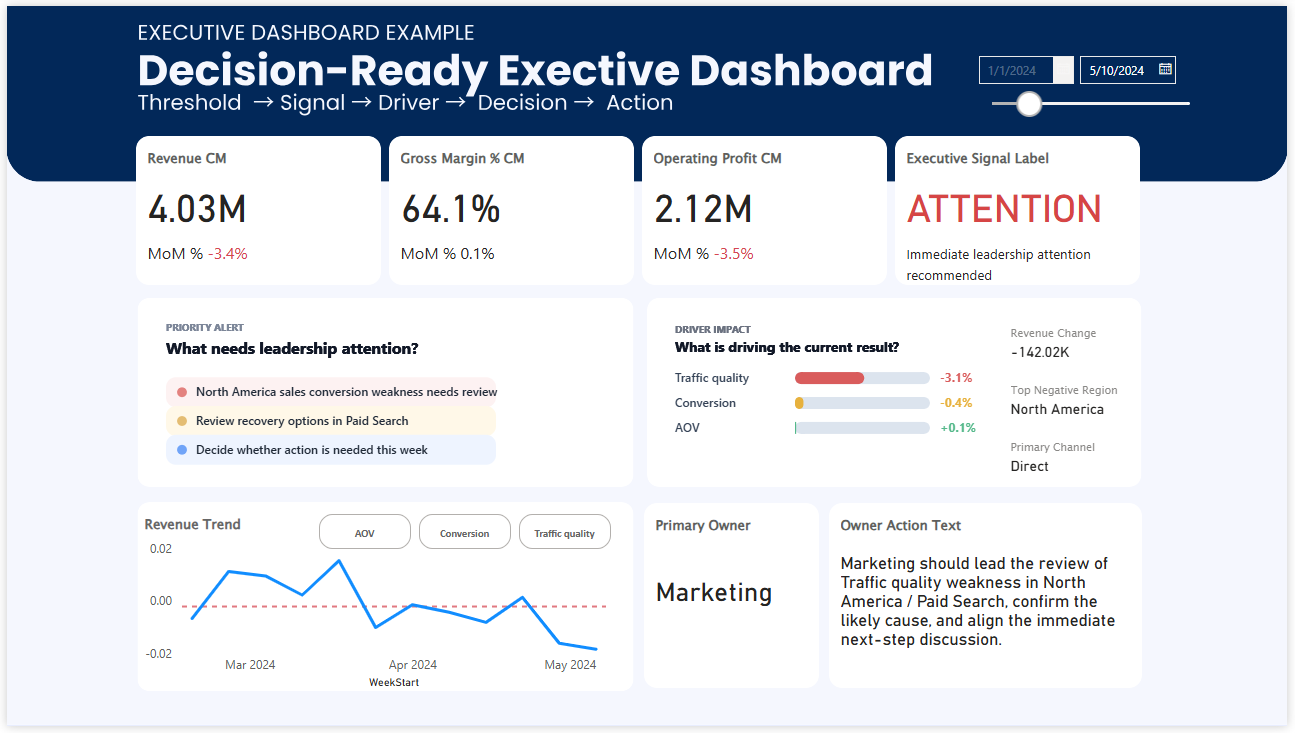
A traditional dashboard shows performance. A decision-ready dashboard helps structure the response.
It does not stop at reporting. It makes the discussion more focused by helping the team see:
- what deserves attention
- what is driving the change
- what action should be discussed
That is the key difference. A normal dashboard helps people look at the business. A decision-ready dashboard helps people decide what to do about it.
In that sense, the dashboard becomes closer to a true decision support system.
Decision Architecture
From decision support systems to decision architecture
Traditional decision support systems tried to help people decide with information.
But modern organizations need something more explicit: a structure that connects metrics, signals, drivers, and actions.
This is what Decision Architecture describes.
It is not just a dashboard design idea. It is a way to structure how decisions happen across teams.
Conclusion
Are dashboards really decision support systems?
They can be.
But only when they do more than display performance.
A real decision support system should reduce ambiguity, align attention, and make action easier to discuss.
That is why the next step is not simply building more dashboards.
The next step is designing dashboards that support decisions.
Dashboards do not become decision support systems by showing more data. They become decision support systems when they structure decisions.